
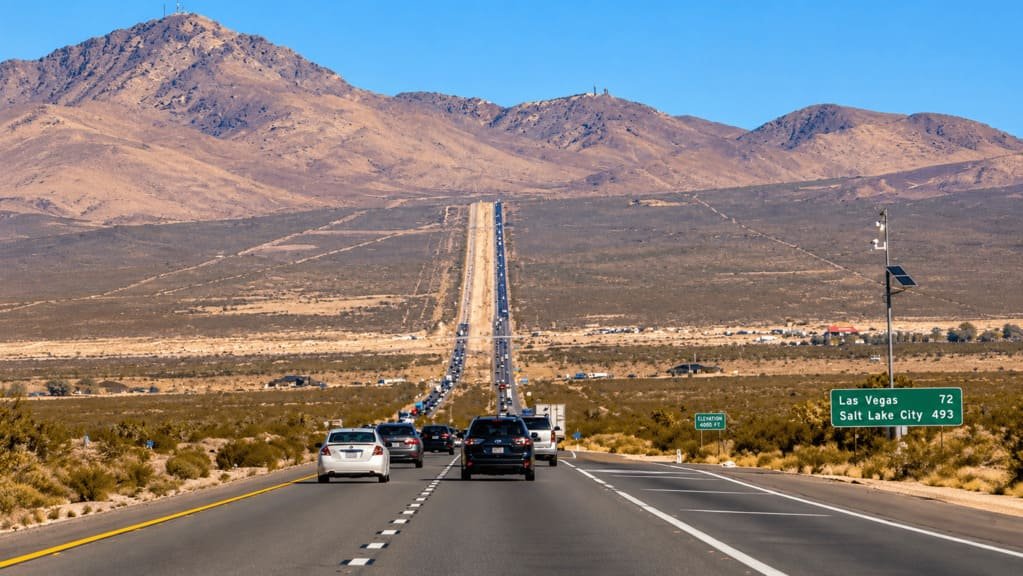
Las Vegas is two starting points. For people who live in the valley, it’s home: a trip begins at the front door and ends there. For visitors, it’s the airport where a rental car starts, and the trip may end in another city. Either way, the destination is only half the decision. Before you pick where to go, decide what shape the trip takes.
Most lists of road trips from Las Vegas answer one question: where can I drive? They sort places by distance or by number of days. This guide answers a different one. Should this be a day trip, an overnight loop, a multi-day loop or a one-way trip, and what does that choice cost in driving, time, return mileage, rental logistics and flexibility? It uses Return Load, a Miles & Mapped planning framework from our guide to one-way vs. loop road trips: the time, miles, money and friction of getting back to where you started.
Road trips from Las Vegas at a glance
| Trip shape | Typical use | Return Load | Best for | Example route types |
|---|---|---|---|---|
| Day trip | Out and back in one day from a Las Vegas base | Concentrated: the whole return drive lands on the same day | Short and medium distances, flexible schedules | Valley of Fire, Grand Canyon West, Zion, Death Valley |
| Overnight loop | One night away, starting and ending in Las Vegas | Spread across two days, and a different road back can turn it into sightseeing | Places too far for a comfortable day | Zion, Death Valley, Grand Canyon South Rim (a stretch case) |
| Multi-day loop | Several nights, ending back in Las Vegas | The return road becomes part of the trip | Trips of three days or more with several stops | Southern Utah parks, Grand Canyon with Arizona’s Route 66 |
| One-way | Starting in Las Vegas, or ending there, and finishing in another city | Return driving mostly drops out, and rental and flight logistics replace it | Fly-in travelers, routes with a natural endpoint | Los Angeles, San Francisco, Salt Lake City |
Return Load is a Miles & Mapped framework, not an industry metric.
Why distance lists can mislead
The principle behind our guide to how many miles to drive in a day applies here: miles aren’t hours. Desert and mountain roads behave differently from interstates, and traffic, stops, weather, construction and closures all change the real drive time. Published lists also give different mileage for the same destination, partly because “Las Vegas” and “Zion” aren’t single points.
So this guide uses drive-time bands for planning, not exact figures: about an hour, two to three hours, four to five hours, and six or more. Treat each as a range and check live routing for your own start point and date.

Choose the shape before the route
Day road trips from Las Vegas
A day trip works when the time at the destination justifies the driving. Weigh the total driving, the hours left at the destination, your departure and return times, the season and heat, and whether the experience is worth the day. The label “Vegas day trip” covers very different loads, so it helps to separate them.
Valley of Fire is the easy case, about an hour from the city, and it’s run by Nevada State Parks.
Grand Canyon West and Zion are longer, borderline day trips. The National Park Service puts Grand Canyon West at about 122 miles and two hours and 15 minutes from central Las Vegas. It is on Hualapai land and outside Grand Canyon National Park, with its own fees. Zion is roughly two and a half to three hours each way (see the park’s directions page), and the day depends on parking and the seasonal shuttle as much as on the road, so read the park’s planning guide first.
Death Valley is a long day trip, and the season changes the equation. The drive to the park is only part of it. The park is very large, its attractions are spread out, and there is significant driving inside it. The National Park Service advises against hiking the low elevations in heat (see its safety page). A winter day there is a different trip from a summer one. Our desert road trip timing guide covers the seasonal logic.
Overnight loops
One night changes the equation. The drive splits across two days, the destination gets an evening and a morning, and the way back doesn’t have to be the same road. Zion works well this way: out to the Springdale area, a night, then back by an easier schedule. Death Valley benefits from a night inside the park area too, because early and late hours are the most comfortable for being outside.
The Grand Canyon South Rim is the stretch case. It’s roughly four and a half to five hours each way (the National Park Service lists it at 278 miles from Las Vegas), so one night leaves most of the first and last days in the car. Treat it as at least a two-day trip, and consider building it into a loop instead. Our Grand Canyon road trip guide covers the park itself.
Multi-day loops
A loop beats out-and-back when the return road adds something new. The return becomes part of the trip instead of dead mileage. The cost is hotel moves and a plan with less slack. Count the moves: a loop built around two bases can beat one built around five.
Southern Utah is the clearest example. The Utah Mighty 5 can be organized as a loop from Las Vegas, depending on the stops you choose.
A second option pairs the Grand Canyon with Arizona’s Route 66. Las Vegas itself isn’t on Historic Route 66. From Las Vegas, the practical connection is through northwest Arizona, with the historic corridor continuing through places such as Kingman, Seligman and Williams. A loop can go out that way toward the South Rim and return another way. If the “Route 66 Las Vegas” question is yours, our Route 66 guide explains how to decide how closely to follow the historic alignments.
A longer circuit linking Zion, Bryce and the Grand Canyon is also possible with several days. Check the driving between each stop before you commit to it.
One-way road trips
A one-way trip is often the most useful shape for fly-in travelers because Return Load largely drops out. You rent the car in one city and return it in another, and you fly home from the end. It’s also the open-jaw pattern: flights into one place and out of another. A one-way rental isn’t automatically easier. It trades return driving for rental terms and flight logistics.
Las Vegas to Los Angeles is the corridor with the most search demand, and it runs in both directions. You can start in Las Vegas and drop the car in Los Angeles, or end in Las Vegas and fly home from there. The drive is about four to six hours depending on traffic and stops. The LA to Las Vegas route page covers the road itself, and our guide to road trips from Los Angeles covers the other end.
Las Vegas to San Francisco is much longer, roughly eight and a half to ten hours of driving on direct routes, and longer on scenic ones, usually split over two days. A one-way saves the most here, because driving back would add another long stretch. Las Vegas to Salt Lake City is about six to seven hours and can pass through southern Utah on the way. To decide whether dropping the return drive is worth it, price that drive in hours, fuel and hotel nights, then set it against the drop charge and the flight home.
On cost: Enterprise’s U.S. one-way policy says some one-way rentals carry a drop charge or mileage charge, that it varies by pickup and return location, that it’s disclosed when you book, and that the rate may be higher. Availability depends on the location, so check your exact pickup and return in the booking tool. Compare total trip cost, including the flight home, as our one-way vs. loop guide explains.

Watch the clock: Nevada, Utah and Arizona
Las Vegas is on Pacific Time. Utah is on Mountain Time, so it’s one hour ahead of Las Vegas all year. Most of Arizona doesn’t observe daylight saving time, as the U.S. Department of Transportation’s time zone overview notes, so its relationship to Las Vegas changes with the season. From March to early November, when Las Vegas is on daylight time, Arizona’s clocks match Las Vegas. In winter, Arizona is one hour ahead, like Utah.
This matters more than it sounds. If you leave Las Vegas at 8:00 a.m. and drive two and a half hours to Zion, you arrive around 11:30 a.m. Utah time. The same shift affects park entry and closing times, timed tours, sunset, campground and hotel check-in, and your return timing. Grand Canyon West lists its hours in Arizona time. Check which clock each booking uses, including your flight home.
Season changes the shape of the trip
Season can decide which shape makes sense. A trip that works as a day trip in cool months may need an early start or an overnight in summer heat. Higher-elevation routes can bring snow and restrictions, and shorter days in winter shrink the usable hours. This article states no closure dates, because they change. Use the desert timing, winter, Grand Canyon and Utah Mighty 5 guides for the seasonal detail, and each park’s own status page for current access.
Flying into Las Vegas? Decide the rental shape first
If you’re flying in, pick the rental shape before you book anything else. A few points to settle early:
- Where you pick up the car and where you return it, since both affect price and availability.
- Whether the one-way you want is allowed. The booking tool will indicate when a one-way rental isn’t available for the locations you’ve selected.
- Total cost, not the base rate: the rental, any drop charge, fuel, extra hotel nights and the flight home.
- Whether a loop spends a day getting back to Las Vegas that a one-way would give you for sightseeing.
- Your flight time. An early departure from Las Vegas limits how far a loop can go the day before.
Don’t buy a non-refundable flight home until the one-way rental is confirmed.
Locals face a lighter version of the same choice. A loop that returns you to your own driveway needs no rental or flight decisions, so the shape question comes down to days, heat and how much of the return drive is worth taking.
How to choose your road trip shape
Five questions settle most of it.
- Where does the trip need to end? If it has to end in Las Vegas, a loop or out-and-back fits. If it can end elsewhere, price a one-way.
- How many days do you have? A day or a weekend points to day trips and overnight loops. Four days or more opens up loops and one-ways.
- Is the return drive useful or just necessary? If the way back repeats the way out, the loop adds little.
- How much hotel movement are you comfortable with? Loops and one-ways usually mean more moves.
- How much uncertainty can the itinerary absorb? Heat, closures and long drives all argue for slack.

How Miles & Mapped plans a trip
Miles & Mapped plans in one order: the shape first, then the stops. Before you build an itinerary, settle where the trip begins, where it has to end and how many days you have. Those three decide the shape, and the shape decides which stops fit. It’s the order the trip planner is meant to follow.
Common mistakes
- Choosing the destination before the trip shape.
- Planning by mileage alone.
- Treating online drive times as guaranteed.
- Forgetting the return leg.
- Assuming a one-way rental is automatically better.
- Ignoring drop-off logistics and the flight home.
- Missing the time-zone change between Nevada, Utah and Arizona.
- Planning a desert route without thinking about heat.
- Treating park access as guaranteed all year.
- Packing too many destinations into one loop.
FAQs
What are the best road trips from Las Vegas? It depends on the shape you want. Short day trips, overnight loops, multi-day loops and one-way routes suit different schedules and return plans.
What are the best day road trips from Las Vegas? Valley of Fire is the easy one. Grand Canyon West and Zion are longer, and Death Valley is long and season-dependent.
Can you drive from Las Vegas to Zion in one day? Yes, but much of the day goes to driving and to parking or shuttle logistics. Many travelers prefer an overnight.
Can you drive from Las Vegas to the Grand Canyon in one day? Grand Canyon West works as a long day trip. The South Rim is a stretch, and two days is more realistic.
Is it better to do a loop or one-way road trip from Las Vegas? It depends on where the trip ends and what the return costs. Compare total cost and travel days, as our one-way vs. loop guide explains.
Can you rent a car in Las Vegas and return it in another city? Often yes, but it depends on the company and the locations. Check the booking tool for your exact pickup and return.
Does Las Vegas have a time difference from Utah? Yes. Utah is one hour ahead of Las Vegas all year.
Is Arizona the same time as Las Vegas? It depends on the season. Most of Arizona matches Las Vegas during daylight saving time and is one hour ahead in winter.
How many days should you spend on a road trip from Las Vegas? It depends on the route shape and how far you want to go. A day trip can work for nearby destinations, while an overnight or two-day trip makes longer destinations more manageable. Multi-day loops and one-way routes become more useful when you want to cover several destinations or eliminate a long return drive.
What is the best road trip from Las Vegas for a weekend? For a weekend, an overnight loop to Zion or Death Valley can work, but the better choice depends on season, departure time and how much driving you want to absorb.
Plan your Las Vegas road trip
Choose the route shape first. Then build the stops around it. Start with the Miles & Mapped trip planner.