Picture a disabled car on a park road, hours from the nearest town, with a roadside membership in the glove box. The driver has a plan, but not yet an answer to three questions. Who manages this road? Who can actually reach a vehicle here? And how does the driver contact them when the phone shows no bars?
A road trip breakdown plan answers those questions before the trip starts. This guide calls the framework the Response Chain, a Miles & Mapped planning framework, not an industry metric. Its three links are Road Ownership, Response Capability and Communication. A roadside plan is one part of it. The road you are on decides who may reach you, and your communication plan decides whether you can call them.
What a Road Trip Breakdown Plan Does and Does Not Reach
A roadside plan is a benefit with terms, not a promise that help can reach every road. Plans differ in how far they tow, whether you choose the destination, where they operate and whether a local contractor is available. AAA’s own comparison guide warns that some providers have low towing mileage limits, so a road trip breakdown in a remote road area may not be covered. This guide does not rank providers or quote prices.
A service area on a map is not the same as access to every road inside it. One credit-card roadside benefit’s published terms say emergency road service is not available in areas not regularly traveled, in off-road areas ordinary towing vehicles cannot reach, or for trailers, campers or vehicles in tow over a stated weight. That is one benefit’s wording, not an industry rule, so read your own plan. The National Park Service’s backcountry-roads page for Death Valley makes the same point from the other side: cell reception is nonexistent in most of the park, towing charges are high and AAA often does not cover tows on dirt roads.
Trailers, RVs and rentals add questions. Is the trailer covered, or only the tow vehicle? Can both be recovered together? Does your rental agreement include assistance, and must you call the rental company before arranging your own tow? Confirm the vehicle you will actually drive.
A plan can authorize a tow without guaranteeing a contractor can reach a particular road. Treat that gap as part of the plan.
Who Responds When Your Vehicle Breaks Down? It Depends on the Road
This is the first link in the Response Chain: Road Ownership. The agency that manages a road is not always the one that can fix or tow your vehicle. Managing a road, answering an emergency, providing mechanical help and arranging a commercial tow are four different things. A road manager sets the rules and keeps the road open. An emergency responder deals with injuries, fire and traffic hazards. A mechanic fixes the vehicle. A tow operator, usually a private company, moves it. One agency or company rarely does all four, so the question for any road is which of them can reach you, and how you reach each. Sequoia’s park page is the clearest example: the park runs the road and an emergency line, and says it does not tow or repair.
| Road or Location | Who Manages It | First Contact | What to Verify |
|---|---|---|---|
| Interstates and state highways | The state transportation department or toll authority | 911 for emergencies. Some states list their patrol’s own number, such as Tennessee’s *THP | Whether a free service patrol operates there. California’s, for example, works in certain areas during commute times |
| National park roads | The National Park Service | The park’s emergency number or 911 for emergencies. A tow company for a disabled vehicle, in most parks | Whether the park dispatches towing, uses a concessioner or leaves it to you |
| National forest roads | The Forest Service, or a state or county for roads it does not manage | Local emergency services, or the forest office | Maintenance level, cell coverage and who pays for recovery |
| BLM-managed roads | The Bureau of Land Management, or another authority | Emergency services, or the field office | Whether the road is BLM-managed at all, and access |
| Tribal roads | The tribal government or its transportation authority, or a state or county | 911 or the tribe’s emergency contact | Who manages the specific road and who responds |
Treat the last two rows as prompts, not rules. This guide found no BLM-wide or tribal breakdown policy, and jurisdiction varies by road and by tribe.
National parks differ, and the park’s own pages say so.
- Sequoia and Kings Canyon: NPS says the parks do not tow or repair vehicles, and that if you are blocking traffic you should call 911 or the park’s emergency communications center. That line is for emergencies, not a roadside hotline.
- Blue Ridge Parkway: NPS says disabled vehicles and vehicles out of gas should be referred to local roadside service or tow companies, and the driver should contact them directly. Rangers do not deliver gas, pull vehicles from mud or provide maintenance. If a vehicle blocks the roadway, contact the park’s communications center.
- Rocky Mountain: NPS says to notify the park using an emergency phone or by getting a message to a ranger station or visitor center, and that towing and road service are available from Estes Park or Grand Lake.
- Yellowstone and Grand Teton: NPS dispatch centers call commercial operators. In Yellowstone, a concessioner is the primary towing and repair provider, and in Grand Teton visitors pay all fees.
Do not generalize from one park. Check the park’s own page and save its emergency and non-emergency contacts before you go. The same is true of forests. The Forest Service says cell signals are not reliable on national forests, even on state highways, and that emergency assistance may not be readily available. One national forest’s alert says there is little to no cell coverage on most forest roads and that towing fees are the visitor’s responsibility. The Forest Service sorts its roads by maintenance level, and level 2 roads are maintained for high-clearance vehicles, not passenger cars. Check how to check road conditions for the sources.

First Steps When Your Car Breaks Down on a Remote Road
Official guidance depends on the setting, so these steps are a sequence, not a script.
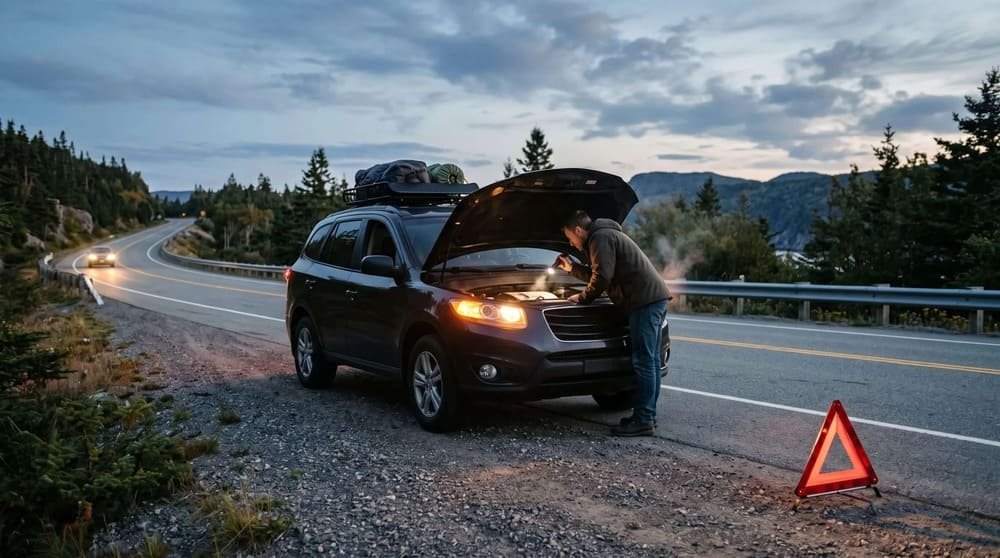
Get safe first. If you can, move out of active traffic. State agencies say to pull as far off the travel lanes as is safe and turn on your hazard lights. If you cannot reach a safe spot, stay visible with your hazards on. Do not attempt a repair in a dangerous position.
Know when to call 911. Wisconsin DOT’s guidance says to call 911 in an emergency. Think injury, fire or smoke, or a vehicle stopped where it threatens traffic. A routine tow is not a 911 call, and Wisconsin DOT notes that highway safety patrols are often moments away on busy roads, so if help arrives before you can call, do not dial 911.
Decide whether to stay with the vehicle. On busy highways, Connecticut State Police and Wisconsin DOT say to stay in the vehicle with your seatbelt on and your hazards flashing when you can do so safely. Leave if there is fire or other immediate danger. In remote desert, the National Park Service says staying with your car is the most important thing you can do, because people have died from exposure walking back to paved roads. The answer changes with the setting: traffic, weather, terrain and whether a safer place exists. Do not apply one rule everywhere.
Know and share your location. Note the road number or name, direction, nearest mile marker, exit, intersection or landmark, and coordinates if you have them. Do not assume an operator can pull your position automatically.
How to Reach Help When Your Phone Has No Signal
This is the third link, Communication. A phone cannot always connect to 911, and emergency calls are not guaranteed from every location or device. Where you have coverage, call. Move to a better-signal spot only if doing so does not add danger. Use official park or agency numbers saved before the trip. Tell a trusted contact your route and expected arrival, so someone notices if you do not appear.
Satellite Messaging and Emergency SOS: What They Can and Cannot Do
Some phones offer emergency messaging through satellite when no cellular service is available, and dedicated satellite communicators exist too. They are not ordinary cell service. One phone maker’s support page says you need to be outside with a clear view of the sky and horizon, that light foliage can slow the connection and that dense foliage, hills, mountains and canyons can block it. It says the feature is limited to certain models and regions and is free for a set period after activation. Dedicated devices differ, and some require a subscription.
An SOS message is not a rescue guarantee, a response time or a tow. Check that your device is compatible and supported where you are driving, activate any service before you leave, try any demo, keep the device charged and carry a backup plan.

Special Cases: EVs, RVs, Trailers and Rental Cars
Electric vehicles. An EV breakdown can be a flat tire, a mechanical fault, a depleted battery or a charging problem, and towing requirements differ by model. Check your owner’s manual and manufacturer recovery instructions, and see the EV road trip guide.
RVs and trailers. Recovery gets harder with size and weight, and not every plan covers every rig. Confirm what your plan covers, including the trailer, before you leave. The RV road trip planning guide covers the larger-vehicle planning.
Rental cars. Read the rental agreement’s breakdown procedure and ask whether you must call the company before you arrange a tow.
Stuck is not always a tow. A vehicle off the road or on a difficult access road may need specialized recovery, which is not ordinary towing and may not be covered.
Build Your Response Chain Before You Leave
This worksheet is a Miles & Mapped planning exercise. Run it for each remote stretch.
Road Ownership:
- Which road will I drive, and who manages it?
- Is it a state highway, park road, forest road, BLM road or tribal road?
- Where is that authority’s official contact information?
Response Capability:
- Does my roadside plan serve this road, and what are its towing and geographic limits?
- Does it cover my actual vehicle, trailer or rental?
- Can a tow truck reach the road, and does the managing agency help or only manage?
Communication:
- Is coverage likely to be limited?
- Have I saved emergency and agency numbers offline?
- Can I describe my location?
- Is my satellite feature compatible and activated, if I carry one?
- Has someone received my route and arrival window?
Backup:
- What if my provider cannot reach me?
- Who is my alternate contact?
- What supplies stay within reach? See the road trip packing list for the full list.
The fuel and services planning guide covers where services are. This worksheet covers who can reach you when you are not at one.
Common Mistakes to Avoid When Planning for a Remote Road Breakdown
- Assuming a membership covers every road
- Confusing managing a road with recovering a vehicle
- Assuming a national park will tow or repair
- Ignoring towing distance and vehicle-type limits
- Relying entirely on cell coverage
- Assuming an SOS feature guarantees a rescue
- Not saving road and agency contacts before departure
- Not knowing how to describe your location

Frequently Asked Questions
What Should I Do if My Car Breaks Down on a Remote Road?
Get safe first, use your hazard lights and decide whether to stay with the vehicle based on the setting. Call 911 for an emergency, not for a routine tow, and know your road, direction and nearest marker.
Does Roadside Assistance Cover Remote Roads?
It depends on the plan’s terms, geographic limits and whether a contractor can reach the road. Some plans exclude areas not regularly traveled.
Will the National Park Service Tow My Broken-Down Vehicle?
It depends on the park. Sequoia and Kings Canyon and the Blue Ridge Parkway say they do not, while Yellowstone and Grand Teton dispatch commercial operators. Check the park’s own page.
What if My Car Breaks Down Where There Is No Cell Service?
Use what you prepared: saved agency numbers, a shared route, and a satellite feature or other backup if you carry one. None of these guarantees a response.
Should I Stay in My Car if It Breaks Down on a Highway?
State agencies generally say to stay in the vehicle with your seatbelt on and hazards flashing if you can do so safely, and to leave if there is fire or immediate danger.
Does Roadside Assistance Cover RVs and Trailers?
Only if your plan says so for that vehicle and trailer. Confirm before you leave.
Plan the Response Before You Need It
PLAN YOUR TRIP YOUR WAY
Build a day-by-day itinerary around your time, pace, interests, and budget.
A roadside membership is useful, but it is not a complete remote road breakdown plan. Before you leave, know who manages the road, who can reach your vehicle and how you will contact them. That is the Response Chain. The Miles & Mapped Trip Planner helps organize a route. It does not provide roadside assistance or dispatch, show cell coverage, check road closures or recover vehicles. For the wider process, see how to plan a road trip and how many miles per day.