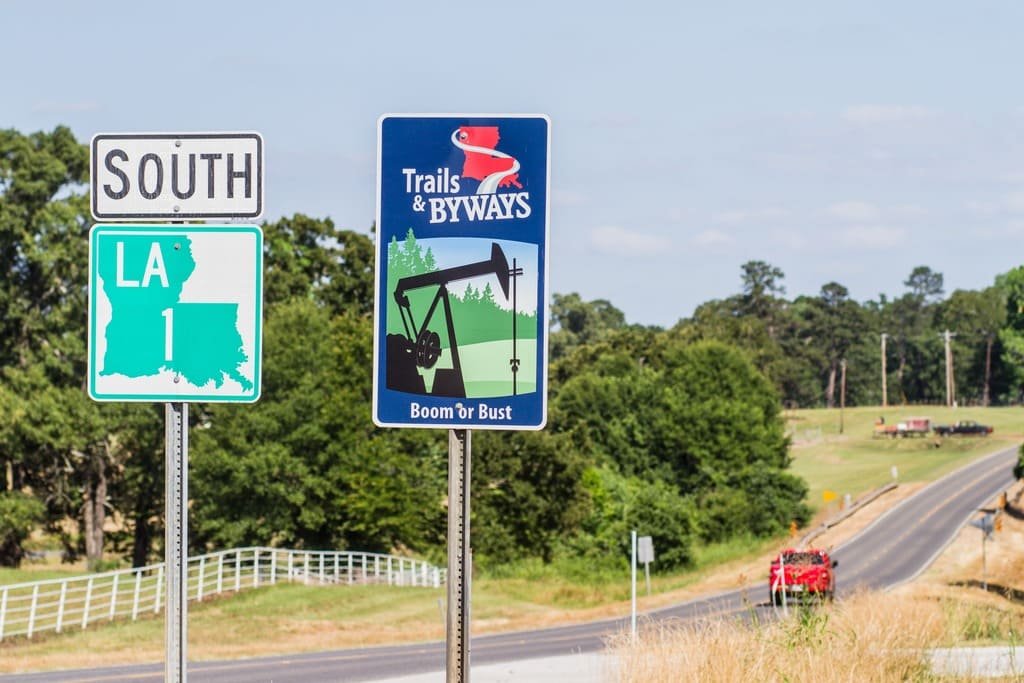
The Boom or Bust Byway runs about 137 miles across northwest Louisiana, following Highway 2 from the Texas state line to Lake Claiborne.
The name comes directly from the region’s economic history, oil and gas, lumber, farming, and entertainment industries that each brought periods of real wealth followed by sharp decline. North Louisiana became an early player in the American oil industry after the country’s first offshore oil well was drilled on Caddo Lake in 1911, and rusted derricks and abandoned oilfield equipment still stand as reminders of that boom and its eventual bust.
The drive passes through rolling hills, pine forest, and small towns across four parishes: Caddo, Bossier, Webster, and Claiborne. AAA Southern Traveler magazine named it a Southern Travel Treasure in 2015, and it became a National Scenic Byway in 2021.
Most people spend a day or two here, splitting time between the route’s small-town museums and its natural stops like Caddo Lake and Lake Claiborne State Park.
Route Details: Boom or Bust Byway
Texas State Line to Oil City (20 miles)
The byway begins near the Louisiana-Texas border along Highway 2, close to Caddo Lake, a 30,000-acre cypress-draped wetland recognized internationally as a Ramsar site for its ecological significance. Oil City holds the Louisiana State Oil and Gas Museum, which uses photos, film, and life-sized dioramas to tell the story of the state’s early 20th-century oil industry, centered on this exact stretch of northwest Louisiana.
Oil City to Vivian and Rodessa (15 miles)
This stretch runs through Vivian, home to the Vivian Railroad Station Museum, which covers the area’s rail history alongside the broader story of north Caddo Parish. Scattered through the surrounding fields, old oilfield equipment left standing since the industry’s decline gives a visible sense of the byway’s namesake boom-and-bust cycle.
Vivian to Shreveport-Bossier area (30 miles)
The route continues southeast toward the Shreveport-Bossier metro area, passing through Caddo Parish’s rural landscape of pine forest and cattle pasture. This stretch offers the most services along the route, along with access to the Red River Crossroads Museum, which covers the region’s Native American heritage, French territorial period, and the Louisiana Purchase.
Bossier to Minden (30 miles)
Continuing east into Webster Parish, the byway passes near Minden, home to the Germantown Colony Museum, which preserves the site of a 19th-century utopian commune that operated as a fully shared community, no individual ownership, for roughly 40 years before dissolving.
Minden to Homer and Lisbon (42 miles)
The final stretch reaches Homer, the Claiborne Parish seat, where the Claiborne Parish Courthouse is the only functioning antebellum courthouse still in use in Louisiana. The Herbert S. Ford Museum, housed nearby, displays local historic artifacts. The byway ends near Lisbon and Lake Claiborne State Park, anchoring the route’s eastern edge in what’s considered some of the highest elevation in the state.
Use the trip planner to build a day-by-day itinerary based on your available time and starting point. Given how spread out the byway’s small-town stops are, picking one or two side trips off Highway 2 rather than trying to see everything in a single day makes for a more comfortable pace.