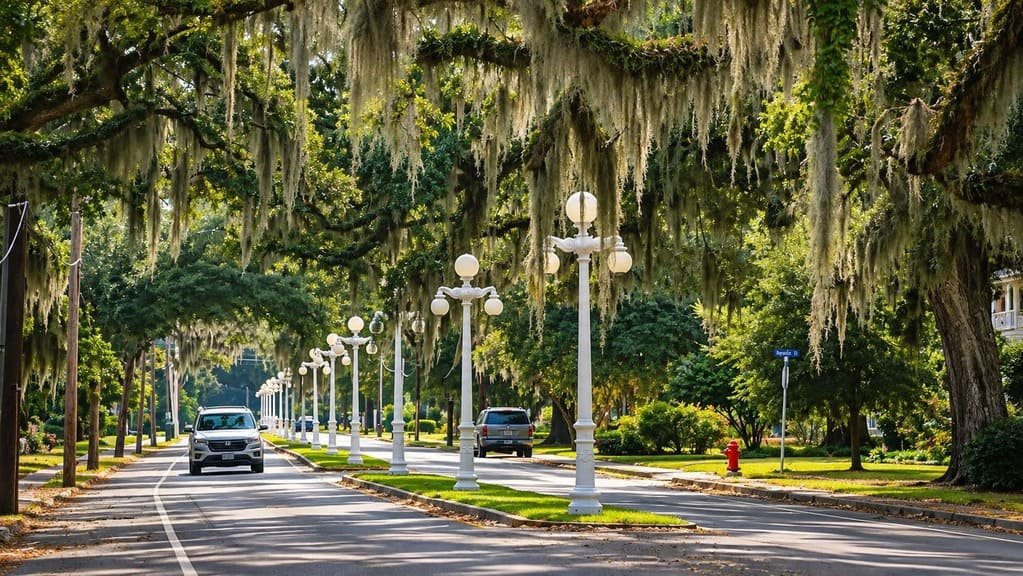
The Bayou Teche Scenic Byway runs about 125 miles through South Louisiana, tracing Bayou Teche from Morgan City north to Arnaudville.
Bayou Teche follows a former channel of the Mississippi River, and its name comes from the Chitimacha word for snake, describing its winding path through the Atchafalaya Basin region. The byway itself isn’t one continuous highway but a set of connected state roads, primarily LA-182 and LA-31, running along the west bank of the bayou, with additional stretches on the east bank through towns like Charenton and New Iberia.
The drive passes through three parishes, St. Mary, Iberia, and St. Martin, connecting towns with well-preserved historic districts and deep Acadian roots. Sugar cane fields, moss-draped swamps, and 19th-century architecture appear throughout, alongside cuisine and music shaped by Native American, French, African, and Caribbean influences.
Most people spend two to three days on the route, since the food and small-town stops reward a slower pace more than the driving itself does.
Route Details: Bayou Teche Scenic Byway
Morgan City to Franklin (20 miles)
The byway begins in Morgan City, where a seawall offers views across the Atchafalaya River, the Mississippi’s main distributary and gateway to the country’s largest river swamp. The town’s historic downtown preserves buildings from its early days as a timber and shrimp processing center, and the nearby Berwick Lighthouse marks the river crossing. Franklin, a short drive north, holds more than 420 structures in its National Historic District, among the best-preserved collections of 19th-century architecture in Louisiana, including the Grevemberg House Museum, an antebellum townhouse filled with Civil War-era artifacts.
Franklin to New Iberia (30 miles)
This stretch passes through Charenton, home to the Chitimacha tribal reservation and the Chitimacha Museum, which covers the history of the bayou’s earliest inhabitants, known internationally for their finely woven cane baskets. In Jeanerette, a town built around Louisiana’s sugar industry, LeJeune’s Bakery still bakes French bread and ginger cakes using 19th-century recipes passed down through generations. New Iberia, the byway’s largest city, serves as a cultural anchor for the route, with a historic downtown built around the sugar and rice industries.
New Iberia to Avery Island (10 miles)
A short detour south of New Iberia leads to Avery Island, home to the McIlhenny Company’s Tabasco Factory and Museum, where the hot sauce has been produced since 1868 using peppers grown on the same salt dome. The island also holds Jungle Gardens, a subtropical botanical garden developed by the McIlhenny family, with a Buddha statue dating to 12th-century China displayed among the plantings.
New Iberia to St. Martinville (10 miles)
St. Martinville is closely tied to the story of Evangeline, the Acadian exile legend later popularized by Longfellow’s poem. The Longfellow-Evangeline State Historic Site preserves an 18th-century Creole plantation home and interprets the area’s Acadian and Creole history side by side.
St. Martinville to Breaux Bridge (15 miles)
Breaux Bridge calls itself the crawfish capital of the world, and the town’s restaurants and dance halls serve up boiled crawfish and étouffée alongside live Cajun and zydeco music, especially on weekends. The Bayou Teche Paddle Trail runs through this stretch, giving visitors a way to see the bayou by canoe or kayak rather than only from the road.
Breaux Bridge to Arnaudville (20 miles)
The byway’s final stretch reaches Arnaudville, a small farming town at the route’s northern end. Bayou Teche Brewing, a local craft brewery built directly on the bayou, makes a fitting last stop, brewing beers themed around Cajun culture and local ingredients.
Use the trip planner to build a day-by-day itinerary based on your available time and starting point. Since the byway follows several connected roads rather than one single highway, treat the planner’s route as one reliable path through it rather than the only way to drive it.