The Midland Trail follows US 60 for 117 miles across southern West Virginia, from the State Capitol in Charleston to White Sulphur Springs. It starts along the Kanawha River, climbs into the New River Gorge area and ends in the Greenbrier Valley.
Along the way you pass Malden, the boyhood home of Booker T. Washington, waterfalls near Gauley Bridge, the overlook at Hawks Nest State Park and the Glade Creek Grist Mill at Babcock State Park. The byway ends in colonial Lewisburg and White Sulphur Springs, home to the Greenbrier resort.
FHWA says two hours to drive it and eight to see the stops. The road runs beside I-64, so you can leave the highway for the byway and rejoin it whenever you need to save time.
Route Details: Midland Trail
Mile markers below are my estimates of distance from the State Capitol in Charleston. Smithers and Gauley Bridge are derived from published AARoads US 60 mileposts.
Charleston (0 miles)
The byway begins at the State Capitol and follows Washington Street East out of town. This is the best place to charge and fuel before the route, with a DC fast charger on Washington Street East at a car dealership and another stall on the west side of the city. Allow time for the Kanawha Riverfront and downtown before you leave.
Malden (7 miles)
FHWA’s route description points out Malden as the boyhood home of Booker T. Washington. It is the first historic stop east of Charleston, and the road here stays close to the Kanawha River as it narrows through the valley.
Smithers, Cathedral Falls and Gauley Bridge (31 to 41 miles)
Smithers is a river town with a family-run burger place that has been open since 1961. Cathedral Falls sits right off the highway before Gauley Bridge, with a short walk to a better view, and Kanawha Falls spans the river just beyond the town. This section has several small waterfalls close to the road, and it is most striking in spring when the river is full.
Hawks Nest State Park and Ansted (48 miles)
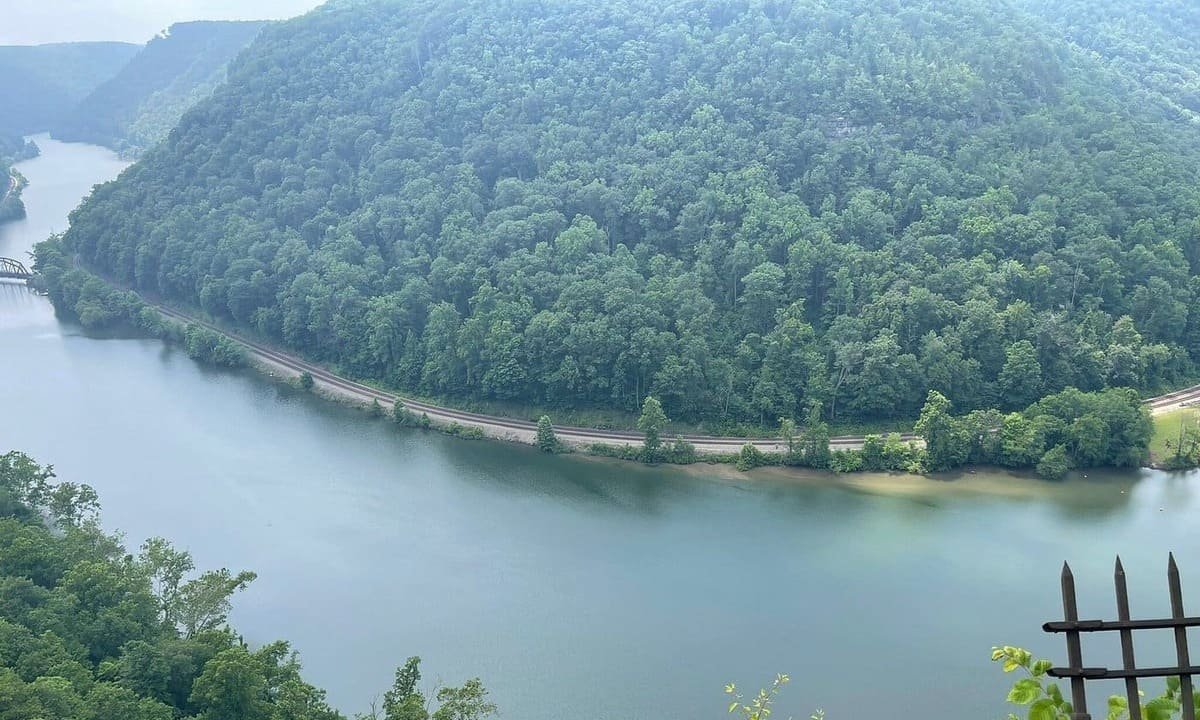
Hawks Nest State Park overlooks the New River, Hawks Nest Dam and the surrounding mountains. A short paved trail leads to the overlook, and an aerial tram runs down to the river. The Civilian Conservation Corps built the park out of land near Gauley Bridge, an area marked by the Hawks Nest tunnel disaster, a hydroelectric tunnel project that killed many workers. Ansted has three small museums, including the Ansted Culture and Heritage Museum. A roadside gravity-defying attraction sits about two miles east of the park.
Hico and the New River Gorge Bridge (56 miles)
US 19 meets US 60 at Hico, and the New River Gorge Bridge is a short drive off the byway on US 19 near Fayetteville. This is white-water country, with rafting outfitters across the region. Cowboy Town in Hico offers horseback riding, and Fayetteville has hotels and restaurants for an overnight stop.
Babcock State Park (69 miles)
Babcock State Park is about 21 miles southeast of Hawks Nest on US 60 and is best known for the Glade Creek Grist Mill, one of the most photographed spots in the state. Trails and creek views make it a good half-day stop. Arrive early in fall, when colors peak and the parking area fills.
Lewisburg (101 miles)
Lewisburg is the colonial town on the eastern end of the byway, with Carnegie Hall (built in 1902 as a gift to a former women’s institute, now part of New River Community and Technical College), the Old Stone Church and a historic downtown. It makes a good overnight stop with more lodging and dining than the gorge towns.
White Sulphur Springs (117 miles)
The byway ends in White Sulphur Springs, home to the Greenbrier resort. FHWA also points to the oldest golf course in the country on the eastern end of the byway. From here, I-64 continues into Virginia.
Use the trip planner to build a day-by-day itinerary based on your available time and starting point.