Baltimore’s Historic Charles Street runs about 12 miles from the Inner Harbor north to Lutherville, following the city’s best-known street through some of its most historic neighborhoods.
Unlike most scenic byways built around natural landscapes, this one earned its National Scenic Byway designation for urban culture, architecture, and history. The street has carried traffic since the city’s early growth and today connects the working harbor downtown to the wooded suburbs of northern Baltimore County.
Along the way, it passes the country’s first Roman Catholic cathedral, the neighborhood that houses the world’s largest collection of Matisse works, and one of Baltimore’s oldest surviving suburban developments. Because much of the drive runs through dense city streets, most people pair short driving stretches with parking and walking through the more concentrated historic districts.
Most visitors spend a day or two on the route, treating downtown Baltimore and Mount Vernon as anchor stops rather than trying to see everything from behind the wheel.
Route Details: Baltimore’s Historic Charles Street
Inner Harbor to Mount Vernon (2 miles)
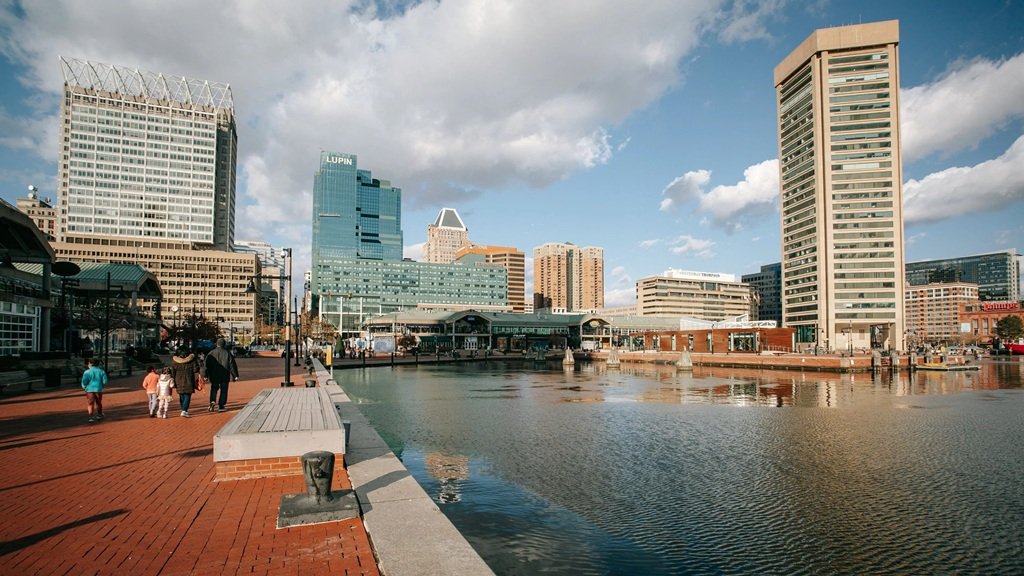
The byway begins at Baltimore’s Inner Harbor, the city’s main commercial waterfront, home to the National Aquarium and Maryland Science Center, both reachable by a short water taxi ride. Heading north on Charles Street, the Hotel Monaco occupies the ornate 1906 Beaux-Arts building that once served as the B&O Railroad’s headquarters. The Basilica of the National Shrine of the Assumption of the Blessed Virgin Mary, completed in 1821, was the first Roman Catholic cathedral built in the United States.
Mount Vernon to Charles Village (3 miles)
Mount Vernon Place, a National Historic Landmark, centers on the Washington Monument, topped with a 16-foot statue of George Washington and predating the more famous obelisk in Washington, D.C. by decades. The neighborhood holds a dense cluster of museums and cultural sites, including the Walters Art Museum, free to enter and home to art spanning ancient Egypt through the 19th century. Continuing north, Charles Village developed in the late 1800s as one of Baltimore’s first suburban neighborhoods, and the Eubie Blake National Jazz Institute and Cultural Center honors the Baltimore-born ragtime and jazz composer.
Charles Village to Johns Hopkins University Area (2 miles)
This stretch passes the Baltimore Museum of Art, also free to enter, holding the world’s largest public collection of works by Henri Matisse among its roughly 90,000 pieces. Johns Hopkins University’s Homewood campus sits just off the byway, its Georgian-style brick buildings marking a shift toward a more open, tree-lined stretch of the drive.
Johns Hopkins to Towson (3 miles)
Leaving the denser city blocks behind, the byway continues into Towson, Baltimore County’s seat, where a short detour east reaches Towson Town Center, a large shopping destination. The Hampton National Historic Site, a short drive off the byway, preserves an 18th-century Georgian mansion along with restored slave quarters and formal gardens, offering a more complete picture of the estate’s history than the mansion alone.
Towson to Lutherville (2 miles)
The final stretch reaches Lutherville, a tree-lined community marking the byway’s northern end. This section feels noticeably more rural than downtown Baltimore, with mature trees replacing the dense brick storefronts of the earlier miles.
Use the trip planner to build a day-by-day itinerary based on your available time and starting point. Given the amount of walking this route rewards, most people treat the drive as a way to move between neighborhoods rather than the main event itself.