Ashley River Road runs about 11 to 13 miles along South Carolina Highway 61, connecting Charleston to Summerville through the Lowcountry’s plantation district.
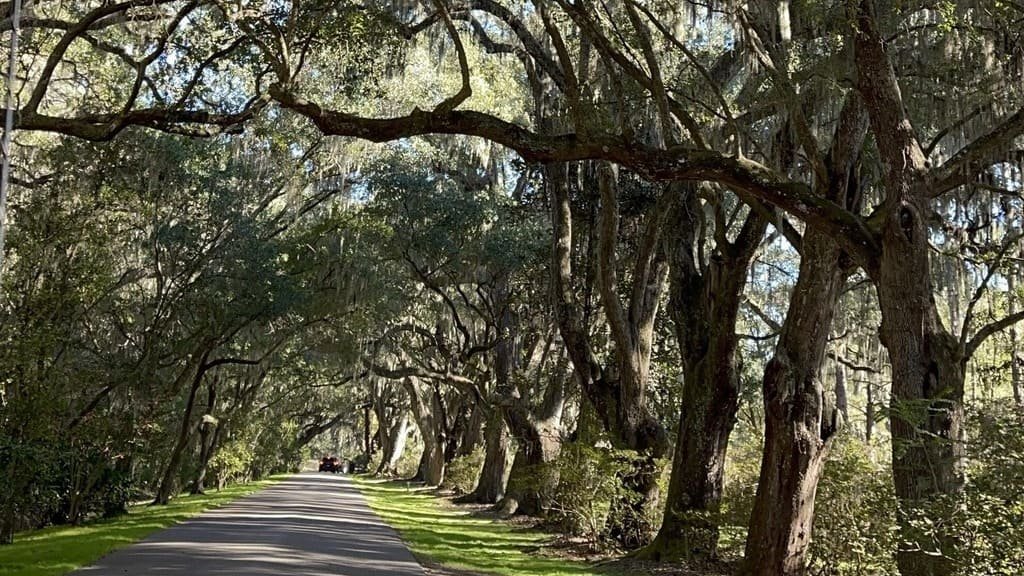
The road is believed to follow a Native American trading route, later formalized by the South Carolina General Assembly in 1691, which makes it one of the oldest roads in the state still carrying traffic today. Live oaks draped in Spanish moss line much of the two-lane stretch, some possibly dating to 1721, when the Assembly barred cutting shade trees along the route.
The byway passes through the Ashley River Historic District, a nearly 24,000-acre area listed on the National Register of Historic Places in 1994. Three plantation sites, Drayton Hall, Magnolia Plantation and Gardens, and Middleton Place, anchor the drive, and all three now include interpretation of the enslaved people who lived and worked there alongside the plantation owners’ history.
Despite its short length, the byway holds two National Historic Landmarks and enough historic depth that most visitors spend closer to two days here rather than the 25 minutes the drive itself takes.
Route Details: Ashley River Road
Church Creek to Old St. Andrew’s Episcopal Church (2 miles)
The byway begins near Church Creek, just outside Charleston, heading northwest on SC-61. Old St. Andrew’s Episcopal Church, built in 1706, is the oldest surviving church structure south of Virginia and South Carolina’s only remaining cruciform-style church still standing from that era.
Old St. Andrew’s Church to Drayton Hall (4 miles)
This stretch passes Fort Bull, a Confederate earthworks position built in 1863 using enslaved labor to help defend Charleston, largely hidden behind trees today. Drayton Hall, built in 1738, is the only plantation house on the Ashley River to survive intact through both the Revolutionary War and the Civil War, and it has never been restored, preserving its original woodwork and plaster in a state closer to how it looked in the 18th century.
Drayton Hall to Magnolia Plantation (2 miles)
Magnolia Plantation and Gardens, founded in 1676, holds the oldest public gardens in the United States, along with one of the finest camellia collections in the world. The current house is the third built on the site, since earlier homes were lost to fire and to Union troops during the Civil War. The Audubon Swamp Garden, a section of the property developed around the property’s original rice-cultivation waterways, is now a wildlife-viewing area for herons, egrets, and alligators.
Magnolia Plantation to Middleton Place (2 miles)
Middleton Place, an 18th-century rice plantation and National Historic Landmark, holds America’s oldest landscaped gardens, first laid out in 1741. The 110-acre estate includes a house museum, an equestrian center, and stable yards where costumed interpreters demonstrate trade skills once performed by enslaved workers on the property.
Middleton Place to Colonial Dorchester (3 miles)
The byway continues toward Summerville, reaching Colonial Dorchester State Historic Site, which preserves the remains of a trading town established in 1697 and active through the Revolutionary War. Visitors can walk among tabby-concrete fort ruins, a bell tower from St. George’s Anglican Church, and an active archaeological dig site, with a small entrance fee for visitors 16 and older.
Use the trip planner to build a day-by-day itinerary based on your available time and starting point. Given how much history sits along this short stretch, most people get more out of treating it as a slow half-day or full-day outing rather than a quick drive-through.